The main towers on both sides of the Libu Yangtze River road-rail bridge in Jingzhou, Central China’s Hubei Province, topped out recently. With a main span of 1,120 meters, it is the world’s largest double-decker cable-stayed suspension bridge. It is scheduled to open in 2028.
The bridge was funded by Hubei Communications Investment Group Co., LTD, designed by China Railway Major Bridge Reconnaissance & Design Institute Co., LTD, and built by China Construction Third Engineering Bureau Co., Ltd and China Railway Construction Bridge Engineering Bureau Group Co., LTD.
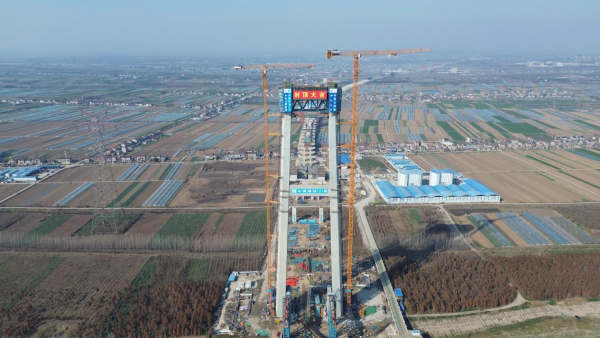
This aerial drone photo shows the tower construction site of the Libu Yangtze River road-rail bridge project in Jingzhou, Central China’s Hubei Province. [Photo/sasac.gov.cn]
The bridge requires advanced, complicated construction techniques and strict quality control for absolute safety. The main body of the north tower contains 38 sections and tapers from bottom to top. The tower’s cross-sections and dip angles varied considerably, necessitating precise casting and non-stop construction.
To overcome these challenges, the construction team made a lightweight smart tower-building machine. The machine climbs synchronously with the tower, automatically adjusting its structural frame to adapt to the narrowing shape of the concrete, automating the entire process. This machine increases construction efficiency by 30 percent, reduces the workforce by 40 percent and reduces the time needed to install a single section to 90 minutes.
The tower-building machine is also equipped with smart systems for curing and temperature control that utilize buried sensors. This allows for fully automated curing of the mass concrete to prevent cracks caused by fluctuations in temperature. Notably, the tower crane operators can engage in high-altitude work from the ground with the help of a 5G remote control system.
(Executive editor: Yuan Ting)