More than 20 Chinese sturgeon fingerlings were seen swimming at the Yangtze River rare fish conservation center of China Three Gorges Corporation (CTG) in Yichang, Central China’s Hubei Province. These roughly 10-centimeter fish are the first group of fry hatched from eggs naturally spawned and fertilized by fully captive-bred parents during a recent "controlled natural spawning experiment" conducted in the Yangtze River. Currently, they have successfully begun feeding and are in good growth condition.
“Their health indicators are normal and they are energetic in the water,” said Zhang Dezhi, a senior engineer who is responsible for fish fostering efforts. Researchers made strict plans to ensure the fingerlings’ healthy growth, including modifying the water temperature and quality to the appropriate levels and supplying them with sterilized feed.
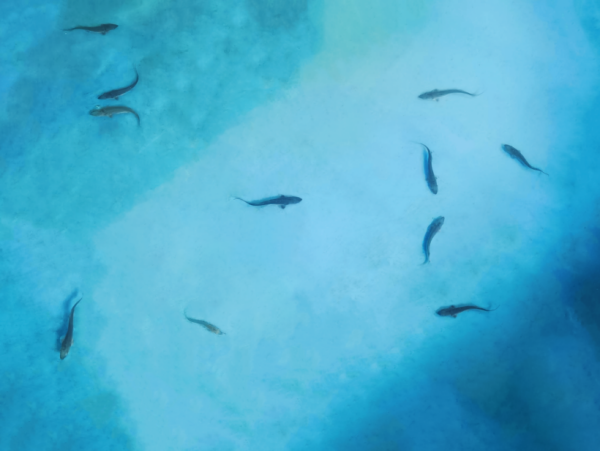
The first group of Chinese sturgeon fingerlings born in the Yangtze River is bred at the Yangtze River rare fish conservation center. [Photo/sasac.gov.cn]
The development of these fingerlings from “spawning and fertilization” to “fry survival” marks a scientific breakthrough for the CTG-led experiment.
The experiment was conducted from late November to early December in 2025, in the section of the Yanzhiba Dam, which is downstream from the Gezhouba Dam. Researchers dug an open channel in the right branch of the Yanzhiba Dam riverbed and set a flow pump to reshape the underwater topography and improve hydrodynamic conditions. Twenty-five fully captive-bred and maturity-regulated adult sturgeons were released into the site for the experiment.
It was observed that once the broodstock adapted to the water temperature and flow pattern, they spontaneously exhibited typical breeding behaviors, such as chasing and swimming in pairs, leading to successful spawning and fertilization. Researchers collected more than 300 fertilized eggs and brought them to the breeding center for hatching and nurturing. CTG researchers now keep monitoring and studying these fry. In the future, they will summarize the results of this experiment to present scientific grounds for the habitat restoration and population recovery of the Chinese sturgeon.
(Executive editor: Yuan Ting)