The world’s first Ro-Ro ship with six rotor sails was launched in Wuhan, Hubei Province, recently. The vessel was built by Wuchang Shipbuilding Industry Group Co., Ltd, a subsidiary of China State Shipbuilding Corporation Limited, for its European client.
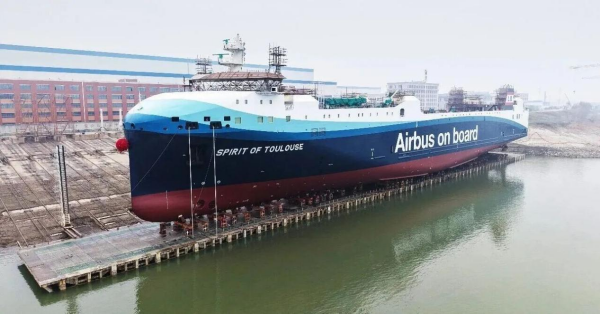
The world’s first Ro-Ro ship with six sails is launched in Wuhan, Hubei Province. [Photo/sasac.gov.cn]
The ship is 169 meters long, 23.32 meters wide and 8.5 meters high, which is designed to draw 5.7 meters of water. It can cruise at 14 knots normally and 17 knots in full sail. It has two main engines and two supplementary engines that can run on both methanol and fossil fuel, as well as two stabilizers.
It is equipped with various advanced automatic systems to optimize energy-consumption efficiency and supervise carbon emissions. Notably, the two main engines, which can switch smoothly between methanol and fossil fuel, will achieve zero-sulphur emissions, and reduce over 80 percent of nitrogen oxide emissions and about 25 percent of carbon emissions compared with standard engines.
The ship is environmentally friendly and intelligent, owing to its mass use of new devices, techniques and technologies. Six chimney-shaped rotor sails are installed on the bow, middle section and stern of the ship. Aerodynamically designed and built with aerospace-grade lightweight composite materials, they can give extra propulsion through the Magnus Effect, and greatly reduce pollution discharge and energy consumption, while increasing the ship’s energy efficiency design index and thus revenues.
The ship will be used to deliver airplane components, carrying per voyage about 70 forty-equivalent-foot containers and six parts of the single-channel aircraft. To meet the special need of transporting these aircraft components, the ship is equipped with a set of roll-on and roll-off systems, including a heavy stern ramp and a large cargo elevator, to swiftly and securely load the large components, optimizing logistics efficiency and avoiding damage to the cargo.
(Executive editor: Yuan Ting)