The Xihe Pump Station in Zhongshan City, South China’s Guangdong Province, has officially begun operations recently. The station boasts the largest single-unit flow capacity in Asia.
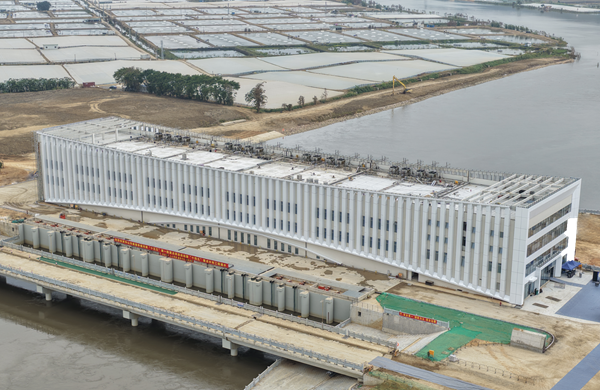
An aerial view of the Xihe Pump Station in Zhongshan City, South China’s Guangdong Province. [Photo/sasac.gov.cn]
The pump station, built by Guangdong Construction Engineering Group Co., Ltd (GCEG), is a provincial key project, a major urban livelihood initiative, and a priority water conservancy project for Zhongshan City in 2023. The pump station is designed to handle various tasks, including draining stagnant water, flood and tidal prevention, and emergency irrigation and water replenishment. It is part of the Xihe Water Conservancy Project, which also includes a sluice and a lock.
The pump station can drain 400 cubic meters of water per second and replenish water at 145 cubic meters per second when necessary. Additional facilities, such as a distribution room, have also been built.
The project faced significant construction challenges due to the soft, water-rich soil, and the water seepage made traditional engineering solutions prone to landslides. After repeated site investigations and experimental trials, the construction team explored new engineering methods in light of the local conditions, thereby securing project safety through advanced technologies.
Regarding the large-volume concrete pour for the pump station base slab, the team improved the concrete mix design, embedded real-time temperature sensors within the concrete, and adopted techniques such as layered pouring and enhanced curing. These efforts successfully ensured the construction quality of the mass concrete, effectively preventing temperature-related cracks.
The pump station will alleviate waterlogging in Zhongshan's central urban area as well as its towns and sub-districts. Beyond disaster prevention and control, its capability for reverse flow operation also allows it to supplement water to the Qijiang River, thus improving the water allocation and boosting the social and economic development.
Looking ahead, GCEG will leverage its expertise in hydraulic engineering to deepen its involvement in the construction of water conservancy projects within the Guangdong-Hong Kong-Macao Great Bay Area. Through innovative technology and management, GCEG stands ready to undertake more endeavors for the “Happy River and Lake” initiative in Guangdong and to bolster water security capabilities throughout the Greater Bay Area.
(Executive editor: Yuan Ting)