The 14th Five-Year Plan period (2021-25) was a crucial period for China's automobile industry to grow from large-scale to powerful. Throughout this period, China Automotive Technology and Research Center Co., Ltd. (CATARC) always kept in mind its founding mission to lead the progress of the automotive industry and support to build the national strength through enhancing the automotive industry.
CATARC has remained focused on its main businesses, which are the three core services for the government, the industry, and the public. It has gone all out to enhance its core capabilities in think-tank support, technology supply, application empowerment, and consumption guidance. In serving the construction of an automotive power and empowering the transformation and upgrading of the automotive industry, CATARC has achieved its own high-quality development.
Enhancing Value Chain to Bolster Automotive Power
Over the past five years, CATARC has vigorously advanced the standardization of the automotive industry. It established the China Automotive Standardization Research Institute, initiated the China Automobile Standards Internationalization Center (Geneva), China's first overseas standardization institution, and set up a Beijing branch. CATARC took the lead in releasing 14 international standards, and it is currently leading to develop 27 additional international standards. CATARC has driven the formulation of over 800 automotive standards, significantly enhancing China's voice in the field. It has also built an authoritative think-tank for the automotive sector by establishing an automotive strategy and policy research center. These entities have supported the government to introduce nearly 100 major industrial planning policies, including the new energy vehicle (NEV) industry development plan (2021-2035) and other policies on NEV consumption subsidies, and exemptions and reductions for NEV purchase tax.
Over the past five years, CATARC has focused on its core business layout of technical services across the entire automotive value chain, and built core advantages in both domestic and international markets to strongly support the high-quality development of automotive enterprises. In R&D and validation, it accelerated the development of localized tool-oriented hardware and software products and the construction of a service capability system, achieved the localized substitution of electronic control simulation test benches, and independently developed the nation's first industrial foundational simulation software for the R&D and design of NEVs. In testing and certification, it has established a world-class automotive testing and certification technology platform. CATARC is also rapidly advancing capability building in areas such as automotive-grade chip testing that answer to "national priorities, industry trends, and urgent needs."
Building New Quality Productive Forces for High-Quality Development
Over the past five years, CATARC has actively responded to the challenges of automotive industry transformation. Key operational quality and efficiency metrics have remained stable with progress, and value creation has continuously improved. Its total assets have essentially doubled, while operating revenue and total profit have maintained steady growth. The labor productivity of all employees has exceeded 1.35 million yuan per person. The core operational efficiency indicators of CATARC, such as R&D investment intensity, operating income margin, and return on net assets, have maintained at high levels within the industry.
Since the start of the 14th Five-Year Plan, CATARC has invested nearly 10 billion yuan, with nearly 60 percent in strategic emerging industries. The revenue contribution from strategic emerging industries exceeds 70 percent. Several new subsidiaries were established to focus on strategic emerging sectors such as carbon digital, chips, software, intellectual property, and cross-border data.
CATARC took the lead in advancing eight key tasks under the industrial renewal initiative and major projects, demonstrating visible results in optimizing its layout and adjusting its structure. Significant efforts have been made to promote the development of new energy and intelligent connected vehicles.
CATARC directed investments towards building a domestically leading, world-class scientific and technological innovation base for NEVs, and established a national demonstration and evaluation platform for hydrogen energy and fuel cell vehicles.
China’s first large-scale comprehensive test field for intelligent connected vehicles in an enclosed area —the Yangtze River Delta (Yancheng) Intelligent Connected Vehicle Test Field, was built by CATARC. It also invested approximately 2 billion yuan to create China's first comprehensive scientific and technological innovation platform covering the entire value chain of intelligent connected vehicles, thereby supporting the high-quality development of China's automotive industry.
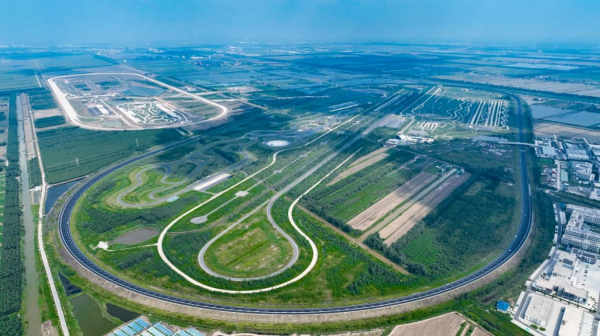
The Yangtze River Delta (Yancheng) Intelligent Connected Vehicle Test Field is China’s first large-scale comprehensive test field for intelligent connected vehicles in an enclosed area. [Photo/sasac.gov.cn]
In the future, CATARC will further strengthen its role in supplying generic technologies for the industry and continuously raise its investment in strategic emerging industries. Focusing on major national strategic tasks such as the self-reliance and self-sufficiency of industrial and supply chains, NEVs, and intelligent network vehicles, it will break through and master more key core technologies in sectors such as high-end testing equipment manufacturing, automotive-grade chip testing, solid-state battery testing, and independent software development. CATARC will notably enhance its comprehensive service capabilities, and inject an unceasing stream of impetus into the rapid development of new productive forces in China’s automotive industry.
(Executive editor: Yuan Ting)