Constructed by China Civil Engineering Construction Corporation and China Railway 15th Bureau Group Corporation Limited under China Railway Construction Corporation Limited, Magufuli Bridge, the longest extradosed cable-stayed bridge in Africa, spans the shimmering waters of Lake Victoria in Tanzania. The bridge is regarded as a symbol of the headway-making spirit with which Chinese enterprises can transform impossibilities to tangible achievements.
After breaking ground on the project, the construction team was confronted with a cluttered lakebed. Granite, with a formidable solidity of 150 MPa, lay blanketed by dozens of meters of heavy mud. Common drilling techniques were ineffective against the slippery sludge and the impenetrable rocks. To tackle the challenge, multiple techniques were developed and trial constructions were undertaken, leading to the innovative combination of two drilling rigs, one for rotary drilling and the other for percussion drilling. The rotary rig was engineered to cut through the mud before the rocks were penetrated by the percussion equipment. Engineers also modified these devices to enhance their efficiency.
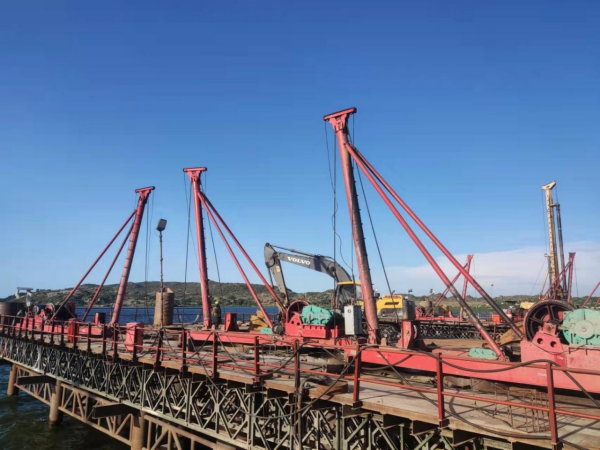
Magufuli Bridge’s piers are under construction. [Photo/sasac.gov.cn]
But more difficulties arose. Because it was an inland lake region, ocean transport of large, heavy cranes was out of the question. The inadequate lakeside roads hindered the transportation of heavy equipment crucial for installing the 955-ton hanging boxes for the main pier and the 585-ton hanging boxes for the side pier. To deal with these obstacles, the construction team adopted a new hybrid building method. They prefabricated all the box components and assembled them above the water instead of transporting and installing entire boxes.
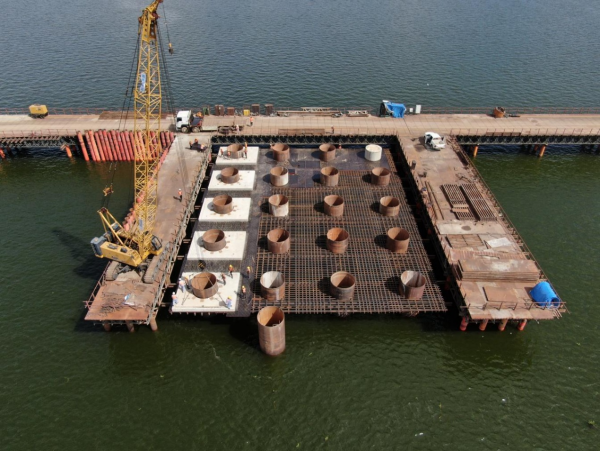
Waterproof technology is used in the construction of the Magufuli Bridge to prevent water pollution. [Photo/sasac.gov.cn]
The main bridge is a three-tower, double-cable-plane extradosed cable-stayed bridge with a deck width of 30.85 meters and tower heights of 18.8 meters. Its unusual structure compounded the difficulty of the construction, which necessitates the synchronization between operating five sets of hanging baskets on cantilever pouring and installing supporting cables. The team introduced advanced model analysis technologies for construction simulation, so as to predict and prevent potential collision risks.
The team prioritized the protection of Lake Victoria while pursuing efficient, high-quality construction. The lake, an important water source for millions of people, plays a crucial role in local livelihoods and production. Under construction, the bridge was encrusted with rubber capsules to prevent water pollution. This approach sustained the local fishery throughout the building process, earned widespread recognition from both China and Tanzania, and was awarded with multiple patents.
With intelligence and courage, Chinese enterprises resolved many conundrums in the construction of Magufuli Bridge. The concrete colossus stands as a symbol of innovative cooperation between China and Africa and as a testimony to the world that creativity overcomes challenges.
(Executive editor: Yuan Ting)