China Southern Power Grid (CSG) announced that its power transmission volume in China’s west-to-east power transmission program reached a record high of 261.6 billion kilowatt-hours in 2025, representing an increase of 31.1 billion kilowatt-hours compared to the volume of 2020.
During the 14th Five-Year Plan (2021-25), CSG has transmitted 1.14 trillion kilowatt-hours of electricity through its 8 alternating current corridors and 11 direct current (DC) ones, saving 330 million tons of coals and reducing 860 million tons of carbon dioxide emission, making a huge contribution to China’s green development.
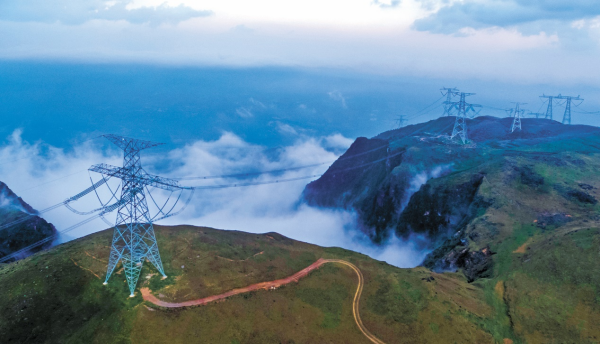
The Kunliulong DC project delivers clean power from Yunnan Province to energy-gobbling areas in Guangxi Zhuang Autonomous Region and Guangdong Province. [Photo/sasac.gov.cn]
The consistent growth in transmission volume, achieved without building new corridors, can be attributed to a combination of factors on both demand and supply sides.
On the supply side, the western China witnessed ample rainfall in 2025. Southwest China’s Yunnan Province reported a 6 percent year-on-year increase in hydroelectric output and a 14 percent rise in new energy power generation. On the demand side, robust growth in cutting-edge industries, such as the digital economy and advanced manufacturing sector in the Guangdong-Hong Kong-Macao Greater Bay Area drove a substantial increase in electricity consumption. In particular, South China’s Guangdong Province became the first provincial-level administrative region to surpass 160 million kilowatt-hours in electrical load.
Digital technology and refined management also unleash potential. “As a primary operator of the west-to-east power transmission program, we align production plans with the power supply schedule and conduct inspections and repairs during supply internals,” explained Feng Dong, Production and Technology Manager of a CSG’s ultra-high voltage subsidiary, “All corridors operated at maximum efficiency this summer, reducing supply internals to 5 hours, an 80 percent decrease from last summer.”
This subsidiary conducted 26 repairs on DC corridors and completed 153 tasks without interrupting transmission, avoiding more than 350 hours of outage.

On December 27, 2025, the Longmen Convertor Station of the Kunliulong DC project welcomes its fifth anniversary of safe operation. [Photo/sasac.gov.cn]
In the summer of 2025, CSG ensured that more than one third of its DC corridors maintain uninterrupted operation to meet peak demand, daily power transmission hitting a peak of 1.15 billion kilowatt-hours.
Market plays a big role in promoting clean energy transmission and consumption across provinces and regions. “The west-to-east power transmission initiative has evolved with an expanding scope of cross-regional mutual support, and the national unified electricity market connectivity mechanism has been fully established,” said Xie Yigong, Deputy General Manager of a CSG’s power dispatch center. A spot power market underwent trials last year for continuous settlement with the first cross-sector deal made between CSG and the State Grid Corporation of China.
In 2025, CSG transmitted over 6.4 billion kilowatt-hours of power through multiple west-to-east corridors to areas beyond its service territory, and delivered 25.1 billion kilowatt-hours of power through the spot market in the second half of the year. Within its own grid region, CSG generated 950.3 billion kilowatt-hours of clean electricity, accounting for 58 percent of the total, a 4 percent point increase compared to the previous year.
According to Xie, since the 14th Five-Year Plan, CSG has encountered challenges in maintaining a stable power supply due to the growing share of new energy in the power mix. He also emphasized that CSG is prepared to employ a range of measures to stabilize power supply in the future.
(Executive editor: Yuan Ting)