In the vast land of north Nigeria, the Kaduna-Kano Railway extends from the terminus of the existing Abuja-Kaduna Railway, passes through Zaria and reaches Kano, a major industrial city in north Nigeria. The diesel-powered railway has six newly built modern stations, a total length of 203.8 kilometers and a designed speed of 150 kilometers per hour. carrying both passengers and freight.
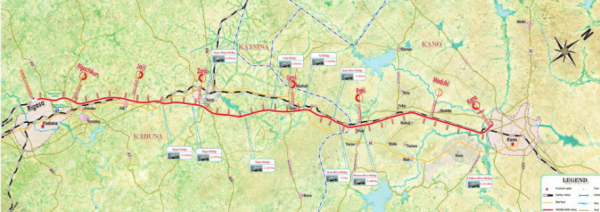
The route of Kaduna-Kano Railway [Photo/sasac.gov.cn]
The Kaduna-Kano Railway, an important part of Nigeria's major railway network, is not only a crucial section of the Lagos-Kano railway network, but also an important thoroughfare connecting the capital Abuja, Kaduna State, and Kano State. It greatly improves the transportation landscape in the country’s northwest, promotes industrial development, facilitates people's livelihood, and has significant importance for Nigeria's economic and social development.
Behind this key Belt and Road Initiative project stands a dedicated team. They are the Chinese staff members of the Kaduna-Kano Railway Survey and Design Department, which is established by the Nigeria Regional Headquarters of the CRCC International Engineering Consulting (Fuzhou) Co., Ltd (CIECC) .
Start from scratch
At the end of 2019, the Kaduna-Kano Railway Survey and Design Department was established in Kano City. The unfamiliar environment, complex geology and limited resources made the task particularly arduous. At the beginning, the top priorities were to launch field surveys and finalize the plans. Engineers ventured deep into the wilderness to collect data from all necessary places. However, the sudden outbreak of the pandemic in early 2020 forced the fieldwork to a halt. The department immediately adjusted its approach, shifting focus to office-based route design. The team members repeatedly compared and selected route options, conducted remote consultations with domestic experts, and strived to make the design increasingly better.
In March 2021, field surveys resumed. The department completed the survey tasks in batches. Under the scorching sun, the surveyors often trekked dozens of kilometers with heavy loads. During the rainy season, the engineers waded through water, their clothing thoroughly soaked, to collect samples. At night, the team members would verify data by the dim light of simple lamps. It was through such perseverance that the team members ensured they would hit upon the optimal solution.
Build bridges of mutual trust
Railway construction is not merely about engineering projects. It also involves cross-cultural collaboration. As the design subcontractor, CIECC) must maintain efficient communication with its client (the Nigerian Federal Ministry of Transportation), the general contractor (China Civil Engineering Construction Corporation and its Nigerian subsidiary), the consulting firm (TEAM Corporation) and the governments at all levels along the railway line.
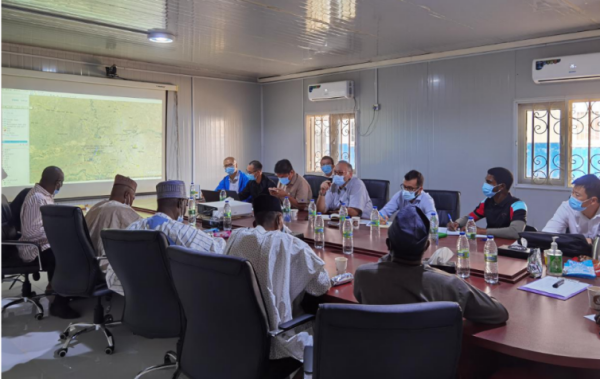
The design team holds a meeting with the consultants and the Kaduna State Government to discuss the proposals for the PAKI Station and the KANO Station. [Photo/sasac.gov.cn]
While finalizing the proposals, the department actively coordinated its planning to ensure that the plans not only met technical requirements but also took local realities into account. The design team established an exchange procedure with the TEAM Corporation through regular meetings, laboratory sharing, joint invitations for expert reviews and so on. These efforts enhanced the scientific soundness of the proposals, and also built a bridge of mutual trust between the Chinese and foreign teams.
Meanwhile, the department established a supporting team for project management, which maintains real-time coordination with the construction team. When construction issues arise, design personnel respond promptly to optimize and adjust the plans to ensure the project progresses smoothly. This collaborative model that integrates design, construction, client and consultant has become the key to efficient construction.
Keep optimizing
Railway construction involves multiple facets including alignment, subgrade, bridges, stations and electrical systems. Faced with complex conditions and tight schedules, the department consistently adhered to the principle of "optimizing design to enhance efficiency."
Drawing on the experiences of building the Addis Ababa-Djibouti Railway and the Lagos-Ibadan Railway, the staff members of the Kaduna-Kano Railway Survey and Design Department repeatedly refined the alignment based on the landform to minimize demolition and reduce costs. Through extensive on-site investigations, they managed to make proposals practical. Experts from China State Railway Group Co., Ltd. were invited to review optimal solutions.
The construction drawings for the civil works and the main projects of the six stations have now been completed, with electrical systems design being advanced comprehensively. Behind these achievements lie countless hours of dedication from all team members of the department.
The significance of a railway
Once completed, the railway will drastically shorten the distance between Abuja, Kaduna, and Kano, facilitating smoother logistics and making people’s traveling more convenient. The project's deeper significance lies in its being a vital practice of the Belt and Road Initiative in Africa. It showcases the power of China's railway to "go global" and highlights the profound friendship between China and Nigeria as the two nations march forward hand in hand.
The construction of the Kaduna-Kano Railway is progressing steadily. Every bit of track and every bridge embodies the dedication and dreams of all members of the Kaduna-Kano Railway Survey and Design Department. As one designer put it: "Our names will not be engraved on the railway tracks, but every train traveling from Kaduna to Kano will bear the mark of our efforts."
(Executive editor: Yuan Ting)