Recently, China General Nuclear Power Group (CGN) announced that its two Hualong One nuclear power projects have commenced initial fuel loading.
The projects are Unit 1 of the Taipingling nuclear power project in Guangdong Province and Unit 1 of the San’ao nuclear power project in Zhejiang Province. They are the first Hualong One reactors in the Guangdong-Hong Kong-Macao Greater Bay Area and the Yangtze River Delta region respectively.
It marks that the main systems of both units have commenced nuclear fuel-loaded testing phase, laying a solid foundation for subsequent steps such as achieving criticality, grid connection, and power generation.
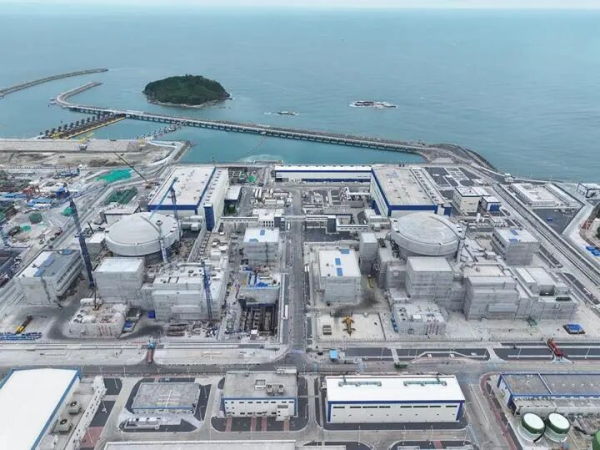
CGN's Taipingling nuclear power project in South China's Guangdong Province [Photo/sasac.gov.cn]
First fuel loading involves placing brand-new nuclear fuel assemblies into the reactor pressure vessel. It marks the transition from non-nuclear tests to nuclear tests in power projects and is a crucial step before a nuclear power plant is connected to the grid for power generation.
During the fuel loading preparation phase, the large engineering and production teams of the San’ao nuclear power project and the Taipingling nuclear power project conducted in-depth coordination and efficient cooperation. Prioritizing safety and quality, they benchmarked the projects against the standards of mature commercial power plants, and addressed key challenges to ensure both sites’ readiness for high-quality fuel loading.
Following fuel loading, the construction team performed subsequent testing in strict compliance with technical regulations and quality standards to ensure high-quality commissioning of the units as scheduled.
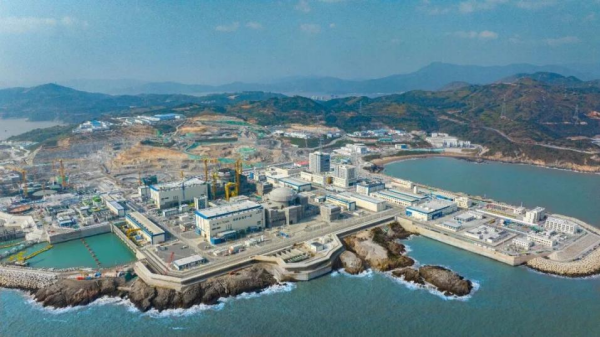
CGN's San’ao nuclear power project in East China's Zhejiang Province [Photo/sasac.gov.cn]
The Taipingling nuclear power project is located in Huizhou City, Guangdong Province, and the San’ao nuclear power project is located in Cangnan County, Zhejiang Province. Each site plans to construct six-million-kilowatt-class pressurized water reactor nuclear power units. The first units of both projects are expected to begin commercial operation in the first half of 2026. Once operational, each unit is estimated to supply nearly 10 billion kilowatt-hours of clean electricity annually, enough to meet the annual electricity needs of one million residents. This is equivalent to reducing the standard coal consumption by over three million metric tons and cutting carbon dioxide emissions by 9.24 million metric tons, equivalent to creating 22,500 hectares of new forest.
(Executive editor: Yuan Ting)