Reflecting on the 14th Five-Year Plan, the State Grid Corporation of China (State Grid) has achieved major advances, driving high-quality development and delivering many remarkable milestones. Thanks to continuous efforts, State Grid has expanded power grid coverage, enabled China to lead the world in installed capacity for grid-connected wind and photovoltaic power, and built the world’s largest ultra-high voltage (UHV) transmission network.
Power transmission capacity keeps growing
From August 4 to 6, the electricity load in the State Grid operating area hit a record high for three consecutive days, peaking at 1.233 billion kilowatts.
During this period, UHV projects nationwide operated at full capacity, rapidly transmitting green energy from the West and North to the populous East and Central regions.
Presently, State Grid has completed and put into operation 41 UHV projects, including 22 alternating current (AC) and 19 direct current (DC) ones. Its cross-provincial and inter-regional power transmission capacity has increased by 30 percent compared with the end of the 13th Five-Year Plan. This summer, State Grid has intensified cross-regional and cross-provincial power transmission efforts, with the maximum transmission capacity exceeding 225 million kilowatts, equivalent to ten times the installed capacity of the Three Gorges Power Station.
In the first half of this year, the market-oriented transaction volume of electricity in the State Grid operating area reached 2.455 trillion kWh, accounting for 75.3 percent of the total. The regular cross-provincial and inter-regional electricity transactions have developed vigorously, enabling efficient flow and optimal allocation of electricity resources across the country. Also, the scale of the green electricity market continues to expand.
The main power grid acts as the energy transmission artery, while the distribution network serves as the capillary connecting households. In Hangzhou, Zhejiang Province, State Grid Hangzhou Power Supply Company uses advanced technologies such as digital twin power grids, 5G plus quantum communication, and live-line operating robots, reducing annual average power outage time per household to 6.01 minutes and achieving top-tier power supply reliability.
High reliability and voltage qualification rates
As of June 2025, State Grid’s comprehensive power supply reliability rate reached 99.95 percent, a 0.089 percentage point increase from the end of the 13th Five-Year Plan. The comprehensive voltage qualification rate reached 99.94 percent, up by 0.082 percentage points.

The Sichuan-Chongqing 1,000kV UHV AC project [Photo/sasac.gov.cn]
Tripling of installed capacity for wind and photovoltaic power
In the first half of this year, State Grid Xinyuan Group’s pumped storage power station completed over 53,000 operations, generating and pumping over 62.6 billion kWh, playing an important role in peak shaving and frequency modulation for the power grid.
These units, storing energy among the mountains and waters, are one of the key supports for State Grid to cope with the volatility of new energy and ensure the safe and stable operation of the large power grid.
As of June 2025, the installed capacity for grid-connected wind and solar power in the State Grid’s operating area reached 1.34 billion kilowatts, tripling since the end of the 13th Five-Year Plan and ranking first globally. New energy is now the largest power source in the area, dominating new installations and generation. At present, China has built the world’s largest clean power generation system.
During the 14th Five-Year Plan, State Grid developed key technologies such as full electromagnetic transient simulation of large power grid and all-domain collaborative security defense system. It built a large scale new energy power grid operation and control system, leading globally in integrating and absorbing new energy.
Large-scale pumped storage power stations, such as the one in Jurong, Jiangsu Province, serve as power grid stabilizers. Also, new industrial forms such as virtual power plants and vehicle-grid integration network are gradually emerging. These have further enhanced the regulation capacity of the power system and promoted new energy absorption.
State Grid Jiangsu Electric Power Co., Ltd. is actively building the vehicle-grid integration network. The vehicle-grid integration network demonstration zone in Wuxi, Jiangsu Province is the largest V2G project in China. State Grid Shandong Electric Power Company has established a green and low-carbon vehicle-grid integration charging station in Jinan and introduced China's first V2G pricing policy.
State Grid is driving the powerful engine of green development through innovations in technology and mechanisms, benefiting pumped storage power stations, virtual power plants, green electricity transmission and market transactions.
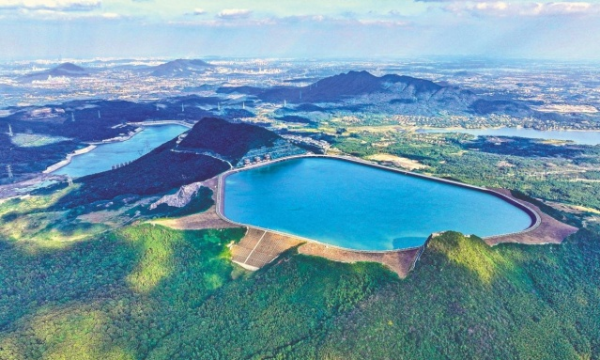
State Grid Xinyuan Jiangsu Jurong Pumped Storage Power Station commences full operation [Photo/sasac.gov.cn]
Big increase in R&D investment
The receiving-end converter station of State Grid Brazil Holding Company’s ±800kV Ultra-High Voltage Direct Current (UHVDC) new energy transmission project began construction on June 30, 2025. As Brazil’s largest transmission project, it uses advanced Chinese UHVDC technology, benefiting 12 million people.
State Grid's global confidence is rooted in its advancements in science and technology. By July 2025, it invested nearly 170 billion yuan in R&D, a 21 percent increase from the 13th Five-Year Plan, leading to significant technological breakthroughs.
Looking ahead, State Grid will accelerate power grid construction and support new energy development, ensuring reliable power for economic and social progress and modernization drive with Chinese characteristics.
(Executive editor: Yuan Ting)