Since the 14th Five-Year Plan, China's manned space program has achieved leapfrog development. As the leading force in building China into a space power and developing the space industry, China Aerospace Science and Technology Corporation (CASC) has fully supported the development of the manned space program and helped China blaze a path of manned space development with Chinese characteristics.
Over the past five years, CASC has successfully completed 20 manned space launch missions. It has sent eight cargo spacecraft (Tianzhou-2 to Tianzhou-9), nine manned spacecraft (Shenzhou-12 to Shenzhou-20), the Tianhe core module, and the Wentian and Mengtian science lab modules into their scheduled orbits. A total of 23 astronauts have been successfully sent into space by CASC, accumulating 27 person-times.
Building the Chinese base camp in space
On April 29, 2021, the Tianhe core module was successfully launched. It serves as the base camp for astronauts’ long-term stay in space and acts as the management and control center of the entire space system.
In 2022, the Wentian and Mengtian science lab modules were launched and accurately docked with the Tianhe core module, forming the space station’s basic configuration in a T shape. With the three modules connected, their energy was integrated into a unified grid, information was shared, and the environment was under unified control. The Chinese people finally built their own long-term crewed space laboratory.
Safer space-ground transportation with higher efficiency
As China’s space station entered the era of application and development, high-frequency and high-reliability space-ground round-trip transportation has become crucial for the manned space project. The Shenzhou spacecraft is facing new challenges. They must not only withstand extreme space environments but also meet higher requirements for long-term on-orbit operation, rapid transition, and regularized operation.
Over the past five years, the Shenzhou spacecraft has achieved multiple technology breakthroughs. The rendezvous and docking time has been shortened from 44 hours to 6.5 hours, significantly reducing the workload for astronauts; the power system has undergone continuous upgrades, with lithium batteries reducing weight and silver-zinc batteries extending service life, helping the spacecraft operate with less payload; the autonomous fault diagnosis and health management technology has been continuously improved, enabling automatic fault diagnosis and handling and minimizing reliance on human intervention.
As an important part of China’s space station project, the Tianzhou cargo spacecraft has carried out multiple consecutive missions over the past five years. It has completed the supply of large quantities of materials and propellants, establishing an efficient and stable space-ground supply system.
The Long March 2F carrier rocket, which undertakes manned launch missions, has a reliability evaluation value of 0.9905 and a safety value of 0.99996. Its unique fault detection, handling and escape system provides a double insurance for astronauts’ safety.
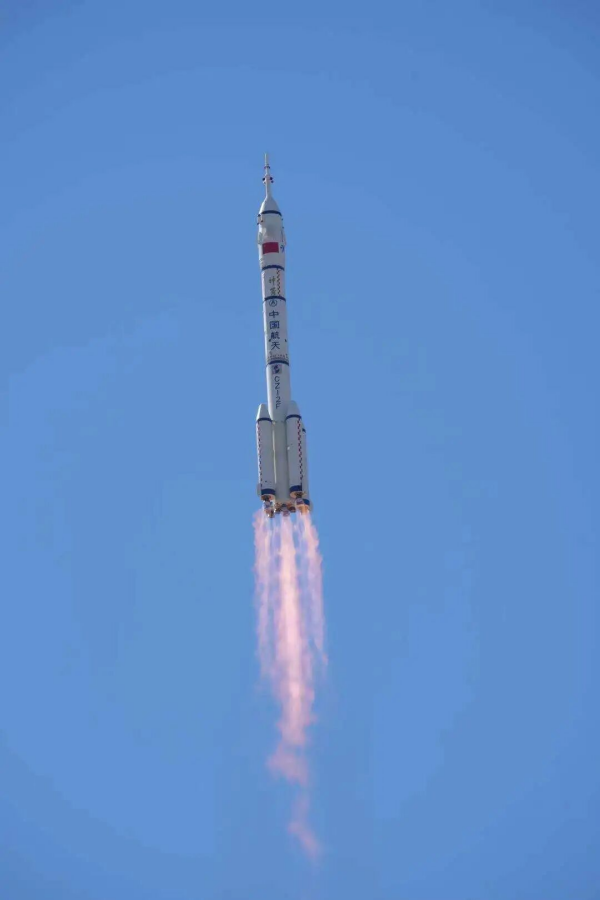
A Long March 2F carrier rocket is launched. [Photo/sasac.gov.cn]
The Long March 7 carrier rocket, which launches cargo spacecraft, and the Long March 5B carrier rocket, which launched the Tianhe core module and Wentian and Mengtian science lab modules, have also made remarkable contributions to building the space station with their high performance and precision.
China’s space station enables long-term stay in space
On June 17, 2021, the Shenzhou-12 manned spacecraft completed an autonomous and rapid rendezvous and docking with the Tianhe core module, and astronauts Nie Haisheng, Liu Boming, and Tang Hongbo entered the Tianhe core module. It was the first time Chinese astronauts entered their own space station. The three astronauts, who were the first visitors to China’s space station, then embarked on a three-month space journey.
On May 30, 2023, astronauts Jing Haipeng, Zhu Yangzhu, and Gui Haichao of the Shenzhou-16 mission entered China's space station. They were the first crew to stay in the station during the application and development phase of the space station, and their entry marked the full launch of application tasks for China’s space station.
At present, China’s space station has accommodated nine mission crews and witnessed six in-space meetings between two crews. Various space application experiments are being carried out in an orderly manner. CASC continues to optimize key technologies such as life support and environmental control systems, and develop related products, providing solid technical support for astronauts’ long-term on-orbit stay and large-scale space applications.
Technological breakthroughs make EVAs regular practices
On December 17, 2024, astronaut Cai Xuzhe, in close collaboration with astronauts Song Lingdong and Wang Haoze, completed an extravehicular activity (EVA) that lasted nine hours, setting a new world record for the longest duration of one single EVA.
Presently, EVAs have become regular tasks for Chinese astronauts. From the Shenzhou-12 to Shenzhou-20 missions, astronauts have conducted frequent EVAs to perform equipment installation, maintenance and experimental operations. These EVAs feature longer durations and more complex tasks, demonstrating China’s comprehensive technological maturity in areas such as spacesuits, robotic arm collaboration and airlock module operation.
Over the past five years, China’s manned space program has achieved continuous breakthroughs and comprehensive leaps at an amazing pace. With high-density launches and successes, an independent, stably operating and highly efficient Chinese space station has been built.
CASC to make new and greater contributions
On June 17, 2025, China successfully carried out a zero-altitude escape flight test of the Mengzhou manned spacecraft, marking a new and important breakthrough in the research and development of China’s manned lunar exploration project.
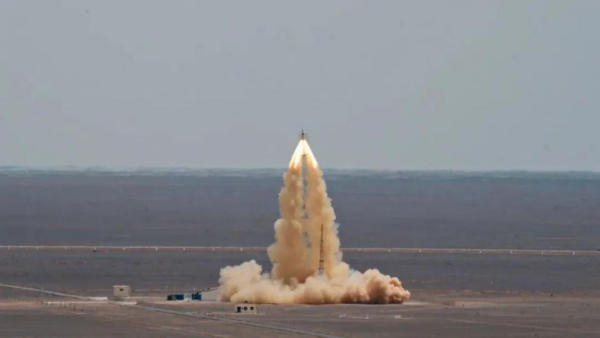
The site of the zero-altitude escape flight test of the Mengzhou manned spacecraft [Photo/sasac.gov.cn]
In the future, the Mengzhou manned spacecraft will serve as the core manned vehicle supporting space station application and development, manned lunar exploration, and other missions. The success of this test has laid an important technical foundation for subsequent manned lunar exploration missions. The research and development of spacecraft undertaking manned lunar exploration tasks including the Long March 10 carrier rocket and the lunar lander is steadily and solidly progressing, and relevant tests will also be organized and implemented as planned.
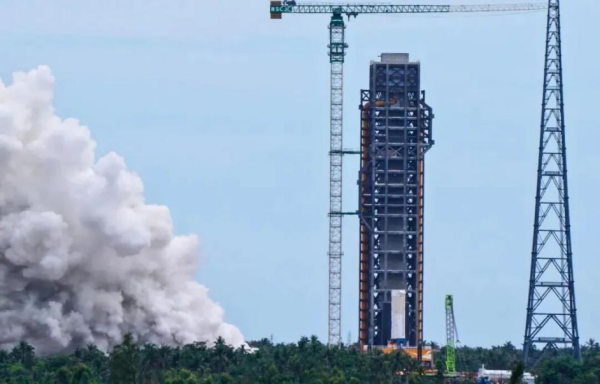
The scene of the first tethered ignition test for the Long March 10 carrier rocket [Photo/sasac.gov.cn]
CASC will continue to pursue independent innovation, continuously improve the technology of the manned space program, and contribute to China’s broader journey toward building a community with a shared future for mankind.
(Executive editor: Yuan Ting)