A zero-carbon desert highway demonstration project has been completed and put into operation in the Taklimakan Desert in Northwest China's Xinjiang Uygur Autonomous Region.
With 86 photovoltaic power stations scattered throughout the shelter forest belt, the shrubs along the Tarim Desert Highway are irrigated with the help of solar power-fueled pumps, instead of diesel ones, making the desert highway the first to achieve zero-carbon emissions in China.
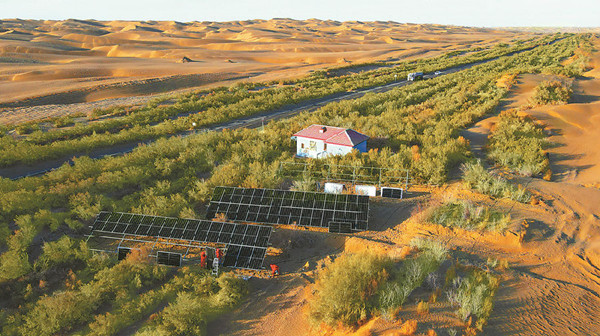
A view of the photovoltaic panels installed in the Taklimakan Desert in Northwest China's Xinjiang Uygur Autonomous Region [Photo/sasac.gov.cn]
Responding to China's "dual carbon" goals of peaking carbon dioxide emissions by 2030 and reaching carbon neutrality by 2060, China National Petroleum Corporation (CNPC) connected 11 water wells to the power grid and built 12 photovoltaic power stations. This year, the company renovated 86 wells previously based on diesel engine-generated power, which is expected to reduce carbon dioxide emissions by 3,410 metric tons annually.
The newly-operable zero-carbon desert highway demonstration project has a total installed capacity of 3,540 kilowatts and is able to generate about 3.62 million kilowatt-hours of power annually. The power output can support daily irrigation of the shelter forest belt for a distance of 436 kilometers.
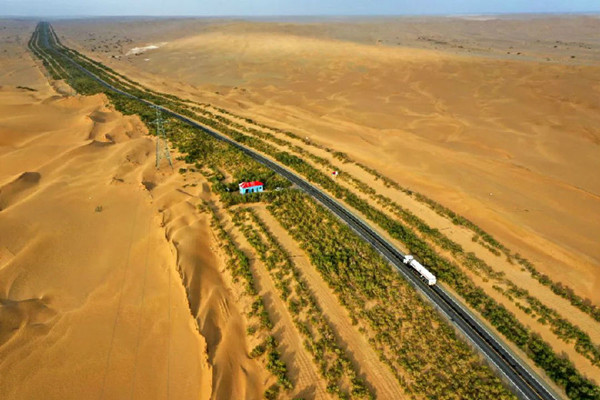
A bird's-eye view of the Tarim Desert Highway in Xinjiang [Photo/sasac.gov.cn]
Completed in 1995, the Tarim Desert Highway has a total length of 566 km, the longest of its kind in the world stretching through a shifting desert. In order to resist the wind and prevent sand storms, CNPC built a 436-kilometer-long shelter forest belt along the highway in 2006.
Near the highway, CNPC has developed and built 32 modern oil and gas fields in the desert hinterland and its periphery, making the Tarim Oilfield the third-largest inland oil and gas field in the country and a main natural gas resource of the west-to-east gas transmission project.
In recent years, the company succeeded in development of the Fuman 1-billion-ton oil zone and two 1-trillion-cubic meter gas zones, and construction of the largest ultra-deep oil and gas production base in China.
Following the concept of "lucid waters and lush mountains are invaluable assets", CNPC has planted forests that cover 483 square kilometers in the Gobi Desert while guaranteeing clean energy supply.
(Executive editor: Wang Ruoting)