The world's largest back-to-back flexible direct current (DC) power project was completed in the Guangdong-Hong Kong-Macao Greater Bay Area and was put into operation on May 25.
The project is a part of a power grid network construction plan that is expected to improve power supply and distribution capacity in South China's Guangdong Province.
It is anticipated that projects involved in the plan will generate more than 188.3 billion kilowatt-hours of power for the country's west-east power transmission program and increase the power interchange capacity between eastern and western areas of Guangdong to 10 million kilowatts in 2022.
Rao Hong, an academician of the Chinese Academy of Engineering and chief technologist at China Southern Power Grid (CSG), said that the project is the first in the world to reasonably partition the complex structure of a power grid, and the first to use flexible DC technology for interconnection of the partitioned grids. It will improve security and stability of the power grid in the Greater Bay Area.
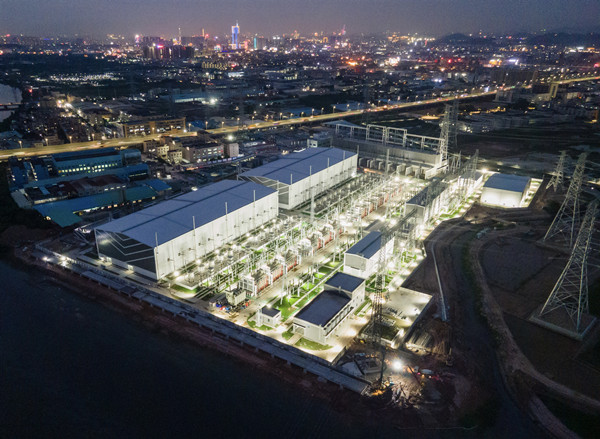
A night view of the back-to-back flexible direct current power project in Guangdong-Hong Kong-Macao Greater Bay Area [Photo/sasac.gov.cn]
Stronger power supply capacity
The Greater Bay Area has the highest power load in South China and its Pearl River Delta region has about 77 percent of the power load in South China's Guangdong Province.
At present, Guangdong is in full swing in developing offshore wind power, aiming to build 10-million-kW offshore wind power bases to support the rapid development of renewable energy.
New energy will eventually be seen in distributed energy systems, the electrical vehicle industry and power storage facilities. They are expected to impact operation of the power system in various ways including generation, transmission and allocation, etc.
The recently-operable back-to-back power project is expected to play a key role in stabilizing safe operation of Guangdong's power grid.
It mainly includes two parts: the Guangzhou power grid linking grids in northwestern and northeastern Pearl River delta regions and the Dongguan power grid linking grids in southwestern and southeastern Pearl River delta regions.
Once operational, the project will improve quick response capacity in shutdown and power failure situations and realize power connection between eastern and western Guangdong and the Greater Bay Area, while power grids in the three areas will remain separate from each other.
Pang Peng, general-manager at the Infrastructure Department of CSG's Guangdong Power Grid Company, said that when all power projects in the Greater Bay Area are put into operation, power supply capacity in the region is expected to grow by 80 percent.
More domestically-made devices
Many new types of equipment have been used in the Greater Bay Area back-to-back DC power project.
According to Wang Liuhuo, project manager at the Infrastructure Department of CSG's Guangdong Power Grid Company, nearly 200 upstream and downstream enterprises were involved in the project.
It's worth noting that half of the Insulated Gate Bipolar Transistor (IGBT) in the Guangzhou project was domestically made, which was a first time in China among similar projects.
IGBT is a core component for energy switching and transmission and is called the Central Processing Unit (CPU) of the power electronic equipment.
What's more, complete autonomous control of key components of the flexible DC converter valve such as the capacitor and IGBT driver board, etc., was also realized in the Guangzhou project for the first time.
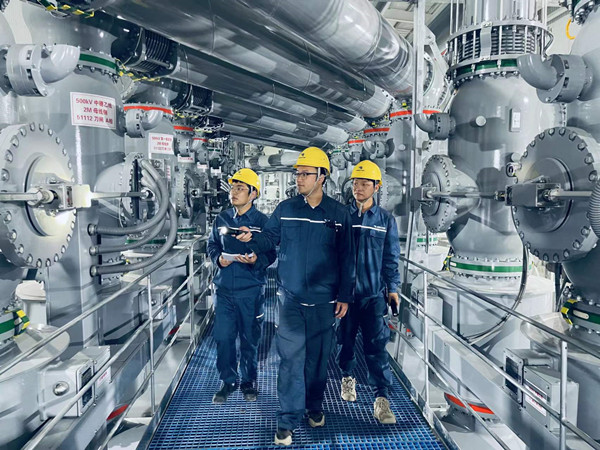
CSG staff members inspect switches and disconnecting devices of the back-to-back flexible direct current power project in the Guangdong-Hong Kong-Macao Greater Bay Area [Photo/sasac.gov.cn]
Greener and smarter converter station
Environmental protection has been a highlight in the back-to-back power project.
For example, an indoor flexible DC transformer water cooling system was adopted for the first time in a grid section in Zengcheng District, Guangzhou, which has low noises and consumes little energy.
Sound isolation and noise protection devices have been installed on the walls of facilities in the Dongguan project, which also reduces noise impact on local residents.
Digital construction and operation is also seen in the project.
China's first full lifecycle three-dimensional smart operation and maintenance converter station was launched during construction. The system will collect both key infrastructure data and real-time terminal operation and maintenance data to realize applications like smart operation, inspection, security and check and repair.
(Executive editor: Wang Ruoting)