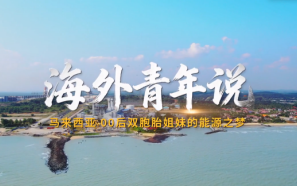
The Meizhou Pumped Storage Power Station and Yangjiang Pumped Storage Power Station in South China's Guangdong Province were put into operation on May 28.
Their operation increased the total pumped storage installed capacity in the Guangdong-Hong Kong-Macao Greater Bay Area to nearly 10 million kW, almost twice the power supply capacity of South China's Hainan Province.
The operation also provided the power grid in the Greater Bay Area with the world's largest pumped storage installed capacity, strongest dispatching ability and highest proportion of clean energy generation.
The two stations were built by China Southern Power Grid (CSG).

A bird's-eye view of a newly-operational pumped storage power station built by CSG [Photo by Li Zhijie/CSG]
Located in Wuhua County, the Meizhou Pumped Storage Power Station features two reservoirs with storage capacities of 41.02 million and 43.82 million cubic meters, ranking second in China in terms of total reservoir capacity.
Construction of the station took only 48 months, setting a record of its kind in the country.
The Yangjiang Pumped Storage Power Station sits in Bajia of Yangchun and is a supporting project of the 400,000-kW hydropower development plan of the nation's 13th Five-Year Plan (2016-20) period.
It has the largest unit installed capacity among China's pumped storage power stations in operation.
It is worth noting that the 700-meter ultra-high hydraulic head pumped storage power generator unit with 400,000-kW super large capacity was independently developed by the company, and the world's first 800-meter hydraulic head reinforced concrete lining waterway was built during construction, reducing building cost by nearly 30 percent.
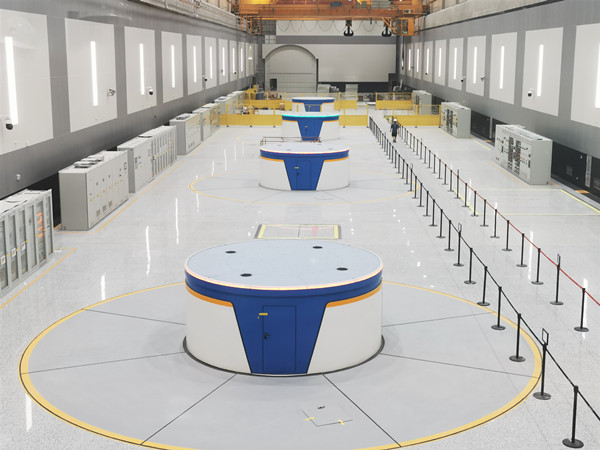
A view inside a newly-operational pumped storage power station built by CSG [Photo/sasac.gov.cn]
Building a world-class clean energy utilization demonstration bay area
With a total installed capacity of 2.4 million kW, the Meizhou and Yangjiang pumped storage power stations are expected to promote large-scale utilization of new energy and support building of the Greater Bay Area into a world-class clean energy utilization demonstration bay area.
Upon operation, the two stations will promote new energy consumption and it is estimated that 2.8 million metric tons of carbon dioxide emissions will be eliminated, equaling the purifying effect of nearly 220,000 mu (14,666.67 hectares) of forestation.
Currently, the Greater Bay Area has a maximum power demand of about 100 million kW in the daytime and 30 million kW in off-peak periods at night, which is a large power utilization difference. The large pumped storage power facilities will store wind power and hydropower in the evening.
At present, the Greater Bay Area has a pumped storage installed capacity of nearly 10 million kW, accounting for 13.8 percent of the power grid average load in the region.
Driving investment in upstream and downstream industrial chains
According to CSG Power Generation Co., Ltd., the two stations have a total investment of about 15 billion yuan ($2.25 billion), and their construction and operation have driven investment of nearly 30 billion yuan in both upstream and downstream industrial chains and provided about 74,000 jobs.
During construction, 121 companies participated in the projects, conquering 87 key technological challenges.
Once operational, the stations are expected to boost development of local business and tourism and each of them will increase local fiscal revenue by about 100 million yuan annually.
CSG is now in full swing in construction of three pumped storage power stations in Zhaoqing and Huizhou of South China's Guangdong Province and Nanning of South China's Guangxi Zhuang Autonomous Region.
The company plans to reach pumped storage installed capacity of 5 million and 15 million kW during the 14th Five-Year Plan (2021-25) and 15th Five-Year Plan (2026-30) periods respectively, supporting new-type power system construction and serving China's goal of peaking carbon dioxide emission by 2030 and reaching carbon neutrality by 2060.
(Executive editor: Wang Ruoting)