
Home > Calendar
China Recycles Its First Satellite on Nov 29, 1975
Updated: 2020-11-29
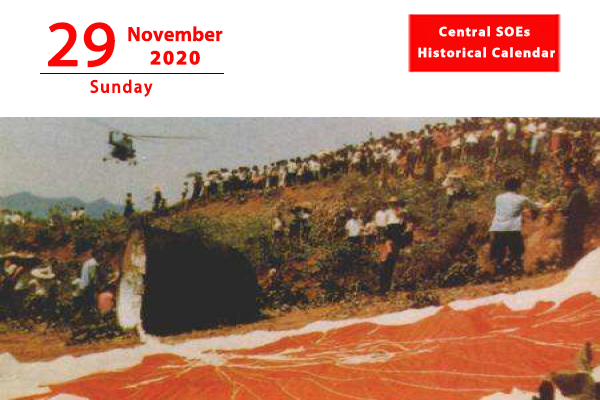
China's first recoverable remote sensing satellite returns to the Earth and is retrieved on Nov 29, 1975. [Photo/sasac.gov.cn]
China recycles its first satellite on Nov 29, 1975
China's first recoverable remote sensing satellite landed on the Earth and was retrieved on Nov 29, 1975, making China the third country able to recycle a satellite after the United States and the Soviet Union.
The 1.5-ton satellite used to be operated on an orbit 173 kilometers from the perigee and 483 kilometers from the apogee. It took the satellite 91 minutes to circle the Earth.
Equipped with an apparatus cabin and a re-entry module, the satellite included various systems to control its temperature, post and programs as well as a camera, a remote-measuring device, and tracking and returning systems.
The filming and recovering systems of the satellite were developed by China Aerospace Science and Technology Corporation.
It collected a great deal of precious remote sensing information and trial data during its service period.
ARJ21, a China-developed regional jet, is delivered to its buyer on Nov 29, 2015
The China-developed ARJ21 regional jet was delivered to Chengdu Airlines on Nov 29, 2015, an iconic achievement in China's aviation industry.
The first new type turbofan regional jet with complete proprietary intellectual property rights, the ARJ21 was also the first self-developed jet to operate on domestic flights in China.
It was proof that China has the capacity to design, manufacture, test, obtain certification for and produce and deliver a regional jet independently.
First generator of China-Pakistan Economic Corridor goes into service on Nov 29, 2017
The first generator of the Port Qasim Coal-fired Power Plant, the first energy project under the framework of the China-Pakistan Economic Corridor, started operation on Nov 29, 2017.
The project was jointly invested by Power Construction Corporation of China and Qatar's Royal Family Holdings AMC with contribution of 51 percent and 49 percent respectively.
It was a new way for Chinese SOEs to make overseas investment.
With about nine billion kWh of electricity production per year, the two 660 MW supercritical generator units meet the power demand of four million households in Pakistan, which relieves the power shortage in affected areas and contributes to local power and energy structural adjustment at reduced cost.
(Executive editor: Wang Ruoting)


Copyright © State-owned Assets Supervision and Administration Commission of the State Council
All rights reserved. Presented by China Daily