
Home > Calendar
Tanggu, China's First Large-scale Port, Begins Operations on Oct 17, 1952
Updated: 2020-10-17
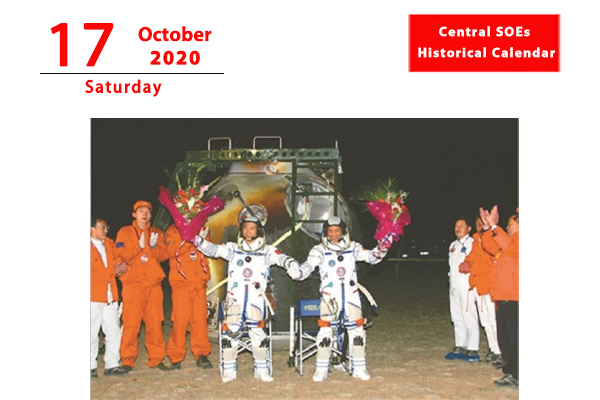
The Shenzhou VI spacecraft, carrying astronauts Fei Junlong and Nie Haisheng, successfully lands on grassland in central Siziwang Banner of Inner Mongolia Autonomous Region on Oct 17, 2005. [Photo/sasac.gov.cn]
Tanggu, China's first large-scale port, begins operations on Oct 17, 1952
The Port of Tanggu, the first large-scale harbor built since the founding of the People's Republic of China, opened for service on Oct 17, 1952.
Contracted by the predecessor of CCCC First Harbor Engineering Company Ltd, the four 3,000-ton berths at the first wharf of the port were renovated into four 7,000-ton berths and an 81-meter pontoon was installed at the second wharf.
In addition, the dredging channel was extended to six meters and the bulwark, storage areas and roads were repaired. Other facilities including coal loaders and locks were also checked and renovated.
The renovated port has a production capacity of 1.3 million tons.
The Port of Tanggu is a part of Tianjin Port and its opening was a turning point for that port's evolution into a seaport from a river port.
Shenzhou VI spacecraft returns to the Earth after 115 hours and 32 minutes of space flight on Oct 17, 2005
The Shenzhou VI spacecraft successfully landed on grassland in central Siziwang Banner of Inner Mongolia Autonomous Region after 115 hours and 32 minutes of space flight on Oct 17, 2005.
China's first manned space scientific experiment was conducted during the spacecraft’s flight.
The astronauts aboard were Fei Junlong and Nie Haisheng.
It was a milestone of China's progress in manned space technology and manned space experimentation.
Shenzhou XI manned spacecraft is launched from the Jiuquan Satellite Launch Center in Northwest China's Gansu Province on Oct 17, 2016
The Shenzhou XI manned spacecraft, carrying two astronauts, was sent into space from the Jiuquan Satellite Launch Center in Northwest China's Gansu Province on Oct 17, 2016 and successfully docked with the Tiangong II space lab.
The two astronauts conducted a series of scientific and technical experiments during their 30-day stay in Tiangong II.
It was China's sixth manned space flight and lasted for 33 days, the longest manned space flight period of the country.
(Executive editor: Wang Ruoting)


Copyright © State-owned Assets Supervision and Administration Commission of the State Council
All rights reserved. Presented by China Daily