
Home > Calendar
China's First Production Line to Improve Lignite Quality Passes Industrial Testing on Sept 7, 2012
Updated: 2020-09-07
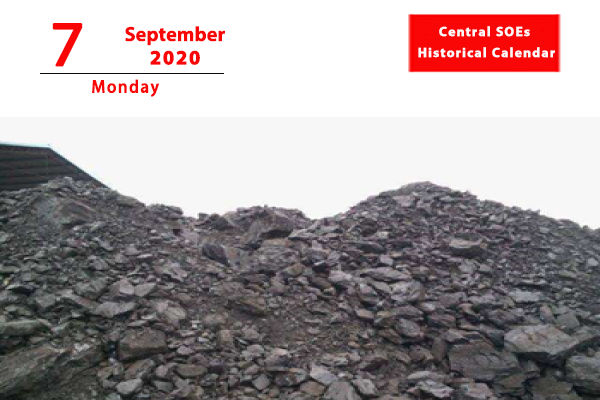
China's first production line to improve lignite quality, with a 500,000-ton output, passes industrial testing on Sept 7, 2012. [Photo/sasac.gov.cn]
China's first production line to improve lignite quality passes industrial testing on Sept 7, 2012
China's first production line to improve lignite quality, with a 500,000-ton output, passed industrial testing after 168 hours of trial operation on Sept 7, 2012.
Developed by China Shenhua Group (which has since merged with China Guodian Corporation into China Energy Corporation),the project was the country's first industrial test on large-scale lignite upgrading.
Its success laid a solid foundation for increasing lignite's economic added value, accelerating industrial upgrading of lignite resources and promoting coal resource development.
Technical skill and industrialization of solar photovoltaic glass kiln is approved on Sept 7, 2016
The technical skill and industrialization of a 750 ton/day oxygen-fueled combustion solar photovoltaic glass kiln, completely developed by China Electronics Corporation, was approved by experts on Sept 7, 2016.
The technology has features like low energy consumption, low emissions and high efficiency and has many proprietary intellectual property rights.
The structural design of the kiln and its process control technology are among the best in the world.
The industrialization was a milestone in China's large-scale oxygen-fueled combustion solar photovoltaic glass production and a major example of the country's future new energy industry.
China's ocean observation satellite HY-1C is launched by a Long March 2C rocket on Sept 7, 2018
China's ocean observation satellite HY-1C was launched into pre-selected orbit by a Long March 2C rocket from the Taiyuan Satellite Launch Center in North China's Shanxi Province on Sept 7, 2018.
Generally developed by China Aerospace Science and Technology Corporation, the HY-1C is used in monitoring ocean color and water temperature and providing environmental change information about China's offshore areas and the world's main coastal zones.
The satellite also helps collect onshore data and ships' information at sea. It services maritime environment monitoring and broadcasting, marine disaster warning, marine rights protection and marine scientific research.
(Executive editor: Zhang Tianyuan)



Copyright © State-owned Assets Supervision and Administration Commission of the State Council
All rights reserved. Presented by China Daily