
Home > Calendar
Construction Starts on Two New 160,000-cubic Meter Liquefied Natural Gas (LNG) Storage Tanks on May 3, 2010
Updated: 2020-05-03
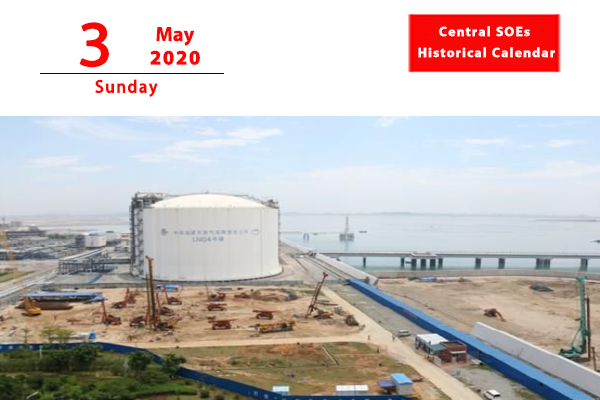
Construction of China's large-scale LNG full containment storage tank with independent technology starts on May 3, 2010. [Photo/sasac.gov.cn]
Construction starts on two new 160,000-cubic meter liquefied natural gas (LNG) storage tanks on May 3, 2010
Construction of two new 160,000-cubic meter liquefied natural gas (LNG) storage tanks started at the receiving station of China National Offshore Oil Corporation in Fujian province on May 3, 2010.
It was China's first large-scale LNG full storage tank project designed, built and operated with independent technology, and showed that the country had completely and independently gained the necessary technology.
The Fujian-based LNG receiving station was the first large LNG project that independently introduced, constructed and operated by Chinese companies in the Chinese mainland and is currently has the largest storage capacity in the country.
The project was significant for China's construction of oil and gas passage at sea.
A guiding opinion on improving corporate governance structure of state-owned enterprises is released on May 3, 2017
The Guiding Opinions on Further Improving the Corporate Governance Structure of State-owned Enterprises was released by the State Council on May 3, 2017.
The opinion accelerated the construction of SOEs' modern enterprise system with Chinese characteristics.
According to the document, a coordinated and effective management structure of the staff should be improved so that all parts play their separate roles.
The opinion also made clear that SOEs must adhere to basic principles including deepening reform, following the Party's leadership and managing the company in accordance with laws, as well as adhering to the Equity Principles of Power and Responsibility.
In addition, the opinion stressed that the subjects' rights and liabilities should be normalized from five aspects - clearing sponsors' responsibilities, strengthening construction of boards, activating managers' vitality, improving supervision systems and adhering to the Party's leadership.
The document also emphasized optimization of companies' regulatory institutional systems.
(Executive editor: Li Shuling)


Copyright © State-owned Assets Supervision and Administration Commission of the State Council
All rights reserved. Presented by China Daily