
Home > Calendar
HAI YANG SHI YOU 981, China's First Self-Designed and Built Sixth Generation Deep-Water Semi-Submarine Drilling Platform Started Drilling Its First Overseas Deep-Water Well on Feb 7, 2015
Updated: 2020-02-07
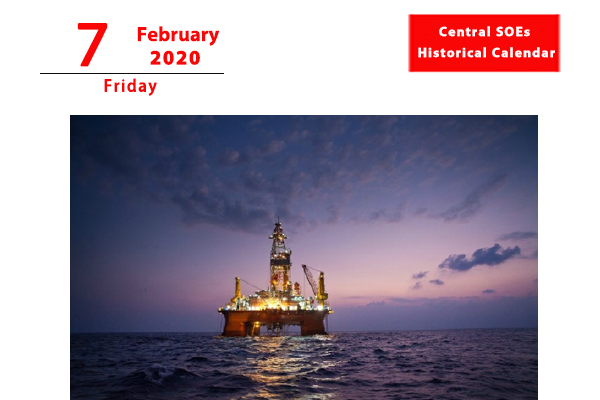
HAI YANG SHI YOU 981 is China's first self-designed and built sixth generation deep-water semi-submarine drilling platform. [Photo/sasac.gov.cn]
HAI YANG SHI YOU 981, China's first self-designed and built sixth generation deep-water semi-submarine drilling platform started drilling its first overseas deep-water well on Feb 7, 2015
HAI YANG SHI YOU 981, the first sixth generation deep-water semi-submersible drilling platform designed and built by China, started drilling on Feb 7, 2015.
Invested and constructed by China National Offshore Oil Corporation (CNOOC), the platform was proof that the company already had international competitiveness in the advanced deep-water industry.
Located in the Bay of Bengal, the well was more than 5,030 meters deep, a record among wells dug by any such platforms in China.
POWERCHINA becomes world's largest blower supplier on Feb 7, 2014
German company TLT was merged into Power Construction Corporation of China (POWERCHINA) on Feb 7, 2014.
The acquisition gave POWERCHINA leading innovation and development capacity, proprietary intellectual property rights and core technology in the blower industry, making it the largest power plant blower supplier in the world.
In addition, the merging was also the largest ever acquisition for POWERCHINA in a European country.
China wins first overseas project on UHV technology on Feb 7, 2014
The consortium of State Grid Corporation of China (State Grid) and Centrais Elétricas Brasileiras (Eletrobras) won the Belo Monte ultra-high voltage (UHV) direct current (DC) send-out project in Brazil on Feb 7, 2014.
The first UHV DC project China had invested overseas, the Belo Monte project was a breakthrough in China's UHV technology going global.
It played a significant role in promoting China's UHV power transmission technology as well as its construction equipment and experience to the world.
The project was a platform to advance Chinese high-end technology and to improve UHV grid construction in Brazil as well as increase economic and trade cooperation between the two countries.
(Executive editor: Wang Ruoting)



Copyright © State-owned Assets Supervision and Administration Commission of the State Council
All rights reserved. Presented by China Daily