
Home > SOEs News
State Grid Promotes Utilization of New Energy
Updated: 2019-09-05
New energy-electricity generation within areas served by the State Grid Corporation of China (State Grid) was 346 billion kWh from January to July this year, a year-on-year growth of 15.3 percent, according to the company.
Electricity generated by solar and wind power was 294.92 billion kWh with an availability rate of 96.3 percent, 2.5 percent higher than last year's rate.
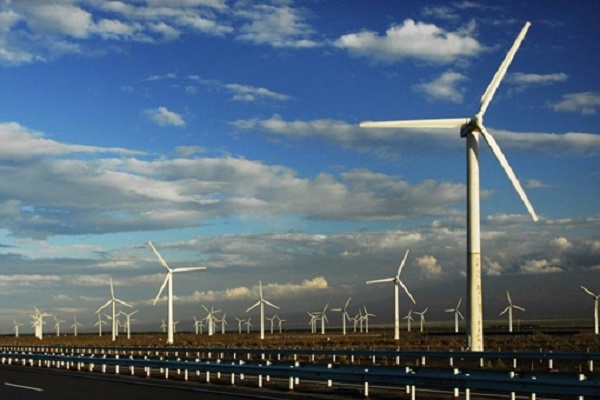
Wind power was greatly used in electricity generation in 2018. [Photo/sasac.gov.cn]
As the largest power grid company in the world, State Grid has made efforts to increase use of new energy-driven power.
The company has taken 22 measures to promote the use of new energy, including construction of grids, dispatching operations, market transactions and technology innovation.
For example, virtual synchronous generator technology has been developed to satisfy large demands for renewable energy.
In addition, a ±500kV flexible HVDC system, a low-carbon and smart power grid for the Winter Olympics and an interactive charging system of electric vehicles (EVs) are being planned to improve stability of the power grid, meet demands like intelligentization, controllability and flexibility of the new-generation power system and guarantee the coexistence of the new energy-driven grid and the older bulk power system.
New energy enterprises have benefited from the new energy-driven power grid in some areas.
For example, Hami Power Supply Co. Ltd. in the Xinjiang Uygur Autonomous Region has China's first and largest comprehensive new energy base integrating wind, solar and thermal power and providing services like grid connection and electronic transmission for businesses.
The company also adopts advanced managing methods to improve wind farms and to achieve universal application of automatic generation control (AGC).
In the Ningxia Hui Autonomous Region, low voltage access is used in areas with high electrical load and a strong grid rack, which makes full use of the power produced in eight local wind farms.
State Grid also proposed to accelerate flexible adaption of thermal power units and complete renovation of equipment that can produce 40-million kW and above in 2019.
Normalizing construction and operation of self-generation coal-fired power plants, managing them as public ones and improving performance of new energy-driven power stations to increase renewable energy's contribution are also part of the company's plans.
In addition, State Grid has promoted construction of the ubiquitous power Internet of Things which will also play a key role in increasing utilization of new energy and building long-lasting and efficient new energy development.
Research and development of new energy big data management platforms will help the company collect core businesses and deal with issues of concern to the government and users. The platforms will improve efficiency and service of the company's global businesses to meet demands of all parties and to support the high-quality development of new energy.
Cross-provincial transmission of new energy-generated power has improved the use of wind and solar power in China.
In Gansu Province for example, since the 12th Five-year Plan (2011-15), State Grid has invested about 76 billion yuan ($10.62 billion) in the province's grid construction. Two 750-kV passages and several 330-kV power transmission projects have been completed.
In August 2017, the world's first ultra-high voltage (UHV) direct current (DC) project, which mainly transmits new energy from Jiuquan in Northwest China's Gansu Province to Central China's Hunan Province, was put into operation. The line has promoted new energy exports in Gansu.
The generating capacity of Jiancaitang Wind Farm in Baiyin, Gansu Province, has been improved since 2016, according to its general manager Wang Xiaoming. "In 2018 we generated more than 160 million kWh of electricity, turning deficit into profit," he explained on July 20.
In addition to Gansu Province, UHV grid construction is also promoted in other parts of China, adding to the country's use of power grid resources, improving new energy exports and supporting high-quality development of clean energy science and technology.
On June 4 this year, the Xiongan-Shijiazhuang 1,000-kW UHV AC electricity transmission project went into production. Since then, the world’s first UHV AC double loop network, which includes the Xilin Gol League-Shandong and the western Inner Mongolia-South Tianjin UHV transmission lines, was formed.
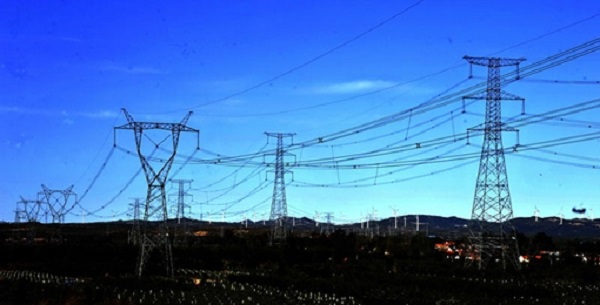
More UHV transmission lines are under construction to promote utilization of new energy-generated power. [Photo/sasac.gov.cn]
The network will contribute to 100 percent clean power supply in Xiongan New Area and guarantee northern China's energy supply.
To meet the import and export demand of new energy, State Grid is accelerating construction of more power transmission passages this year, including the Zhangbei-Xiongan UHV AC transmission line and the Qinghai-Henan, Yazhong-Jiangxi and northern Shaanxi-Wuhan UHV DC transmission lines and the Zhangbei VSC-HVDC transmission line.
Promoting new energy utilization also needs engagement by various parties, such as the government, power supply companies and integrated energy enterprises. In the future, potential new energy industries will also be included in the campaign.
Distributed photovoltaic (PV) power generation is one of the main kinds of new energy.
By the end of 2018, State Grid generated 47.01 million kW of electricity with PV projects, a year-on-year growth of 67 percent.
Other regions in China have also make efforts to fully utilize new energy resources, which has increased local people's income.
Effective use of new energy has relieved power shortage in regions that lack resources and improved living standards.
The company also established a mechanism to guarantee grid security and will optimize the new energy utilization system to improve power transmission.
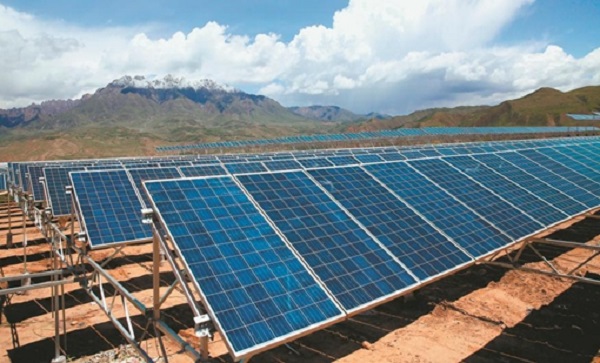
A distributed photovoltaic power (PV) generation project is one of the main kinds of new energy. [Photo/sasac.gov.cn]
(Executive editor: Zhang Tianyuan)



Copyright © State-owned Assets Supervision and Administration Commission of the State Council
All rights reserved. Presented by China Daily